
Reprints after an interrupted batch: restart printing without duplicate mailing
A printer fault, a damaged sheet or a stopped inserter should not require the whole batch to be printed again. Without an exception list, however, the same record can be produced twice or a mailpiece can be missed. A controlled reprint starts with an unambiguous status for every piece and ends only after the batch has been reconciled again.
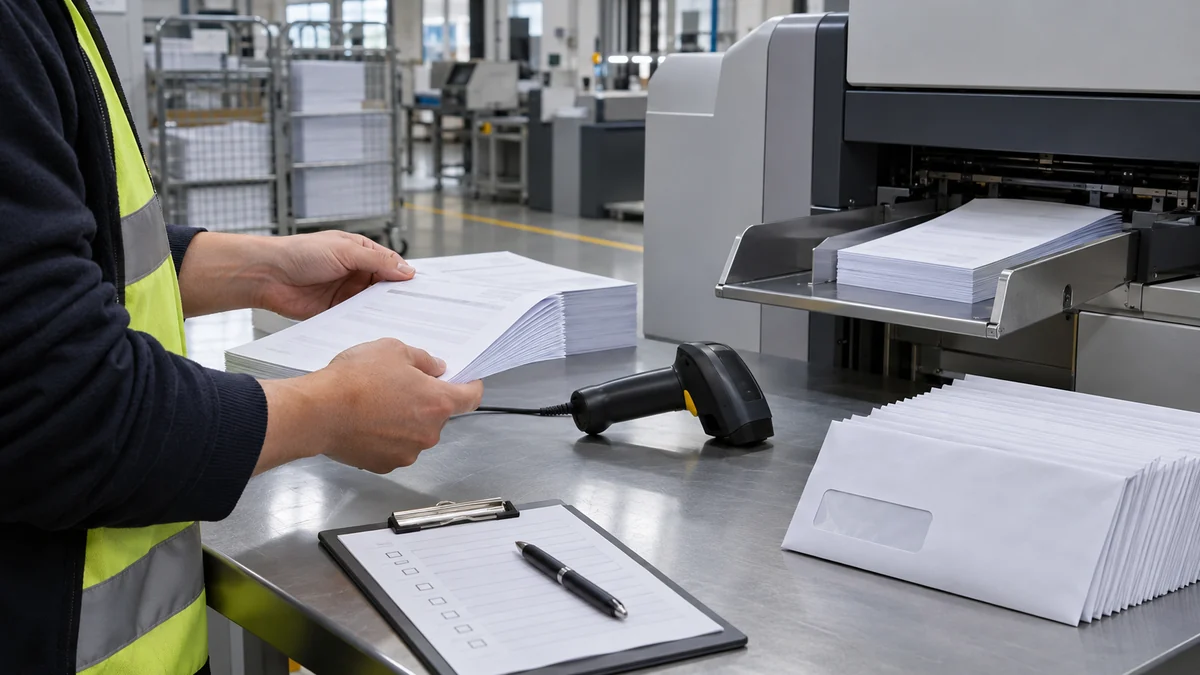
Freeze the batch status, not only the machine
When production stops, record where the process ended: the active batch identifier, records printed correctly, records already transferred to inserting and records rejected. The last page number is not enough because documents may have different page counts and sheets may be between the printer and inserter. A safe restart begins by preventing further status changes and separating states at mailpiece level.
Use one exception list instead of several notes
A reprint queue should come from one exception list, not from a manually reconstructed page range. Each record needs an identifier, a reason and a decision: reprint, reinsert, cancel or investigate. Production-mail systems use piece-level tracking and automatic reprint lists to close the loop between the source file and the physical mailpiece.
Separate reprints from restarting the whole batch
A restart continues from a confirmed checkpoint; a reprint contains only specific incomplete or damaged records. The two sets must not overlap. Before production resumes, compare identifiers in the restart queue with the reprint list and block duplicates. This protects against producing two envelopes for one recipient.
Let the document code guide the full set
Where OMR, 2D or another identifier is used, every reprinted set should keep the same logical mailpiece ID while receiving a controlled next-attempt status. The inserter camera or reader can then check page order, set completeness and consistency with the reference file. A reprint is not new correspondence; it completes an open record.
Separate physical material from the interrupted run
Sheets, envelopes and partly assembled sets left at the machine should move to a labelled exception area. They must not return to live production without a decision. The operator records what was destroyed, what can be reused and what contains data requiring secure handling. This prevents a correct reprint from being mixed with an incomplete set.
Run a control sample before full restart
Treat the first few reprints as a control sample. Check page count, orientation, address position, inserts, envelope closure and identifier reading. Release the remaining queue only after the sample passes. If the device or material changes, also verify print quality and envelope fit.
Reconciliation closes the batch
The source-record count should equal completed, cancelled and unresolved mailpieces. Reprints do not increase the commissioned mailpiece count; they change the production history of selected records. The report should show the interruption reason, reprint scope, control result and approver. Only then should dispatch documentation be prepared and mail handed to the postal operator.
Outsourcing also structures exceptions
BackOffice Outsourcing provides printing, inserting and bulk mailing with batch control and production reporting. The agreed workflow can cover exceptions, reprints and document handover after production. The client receives a reconciled batch and a clear restart trail instead of combining notes from several workstations.
Sources
FAQ
Can the whole file be printed again after a fault?
Only after confirming that earlier output cannot enter the downstream process. A list of specific records requiring reprint is safer.
How can duplicate envelopes be prevented?
Compare restart and reprint identifiers, isolate material from the interrupted run and reconcile every mailpiece before dispatch.
Does a reprint increase the reported mailpiece count?
No. It is another production attempt for an existing record and belongs in its history, not as an extra order.
What should the restart report contain?
The interruption reason, batch ID, reprint list, control-sample result, exception reconciliation and batch-close approval.